

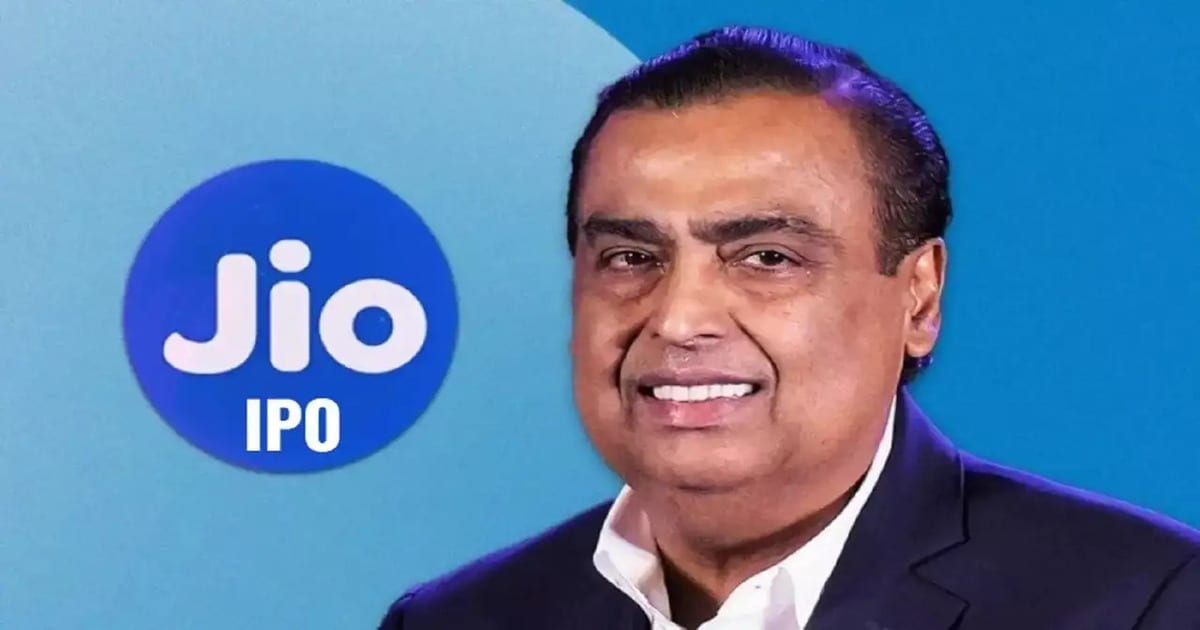
Mukesh Ambani's declaration at Reliance Industries' Annual General Meeting was unmistakably confident: Jio's upcoming listing, he said, would prove that India can build technology companies capable of competing on the global stage. It is a statement loaded with ambition, and one that instantly set expectations for what could become the largest initial public offering in Indian corporate history. Yet a closer look at the numbers behind the pitch suggests the reality on the ground is more complicated than the rhetoric at the podium.
The filing, submitted on June 19, seeks a valuation between $117 billion and $127 billion — a figure that places Jio firmly in the company of the world's most valuable technology platforms rather than traditional telecom operators. That distinction matters enormously to investors, because valuation multiples in the tech sector are typically two to three times higher than those applied to telecom businesses. Global telecom players usually trade at 5 to 8 times EV/EBITDA, a standard reflection of steady but slow-growing infrastructure businesses. Technology platforms, by contrast, command multiples of 15 to 25 times, priced for rapid growth and future disruption. Jio's IPO is asking investors to pay at the tech end of that scale.
The trouble is that Jio's core business today still looks overwhelmingly like a telecom company. Roughly three-quarters of its operations remain tied to mobile connectivity — towers, spectrum, and subscriber plans — rather than the artificial intelligence, cloud, and digital services businesses that are meant to justify a tech-style valuation. Those newer ventures, while promising, have not yet scaled to the point where they meaningfully offset the telecom business in Jio's overall financial picture.
Nowhere is that gap clearer than in average revenue per user, or ARPU, a metric closely watched across the Indian telecom sector. Jio's ARPU currently stands at ₹214 a month, notably behind rival Bharti Airtel's ₹257. On paper, that looks like a modest difference, but scaled across Jio's massive subscriber base, it translates into an estimated ₹27,000 crore in revenue the company is leaving on the table annually compared to what it could be earning at Airtel's pricing levels. For a company positioning itself as India's answer to global tech giants, trailing a domestic rival on a fundamental revenue metric raises pointed questions.
Perhaps most tellingly, the single largest allocation of the IPO proceeds is not earmarked for artificial intelligence research, 6G development, or any of the futuristic technology bets Ambani referenced. Instead, ₹27,500 crore is set aside specifically to repay debt accumulated while building out Jio's telecom network infrastructure — a very traditional use of capital for a very traditional business.
None of this means the bet on Jio is unreasonable. India's digital consumption story remains powerful, and Reliance has a track record of executing ambitious pivots. But investors weighing this IPO are not simply buying a stake in what Jio is today. They are being asked to pay a premium for a story about what it might become tomorrow — and that is a considerably riskier proposition than the AGM stage suggested.












Comments